Cat Care
Portion Control for Cats: A Practical Guide for Pet Parents
Learn how to measure cat food, account for treats, calibrate feeder portions, and monitor a feeding plan responsibly.
Portion control is not about feeding as little as possible. It is about delivering an appropriate daily amount consistently and noticing when the plan needs professional adjustment. Measuring matters because cups, scoops, kibble shapes, and feeder settings can produce very different amounts.
Quick takeaways
- Use grams for more repeatable measurement when possible.
- Treats and shared food count toward the daily total.
- Calibrate an automatic feeder with the exact kibble you use.
In this guide
- Use the label as a starting point
- Measure instead of eyeballing
- Calibrate the automatic feeder
- Account for every source
- Monitor more than bowl emptiness
Use the label as a starting point
Feeding charts estimate needs across broad weight ranges. Your cat’s ideal amount also depends on body condition, life stage, activity, reproductive status, food energy density, and health. Ask your veterinarian to help translate the starting range into a personal plan.
Measure instead of eyeballing
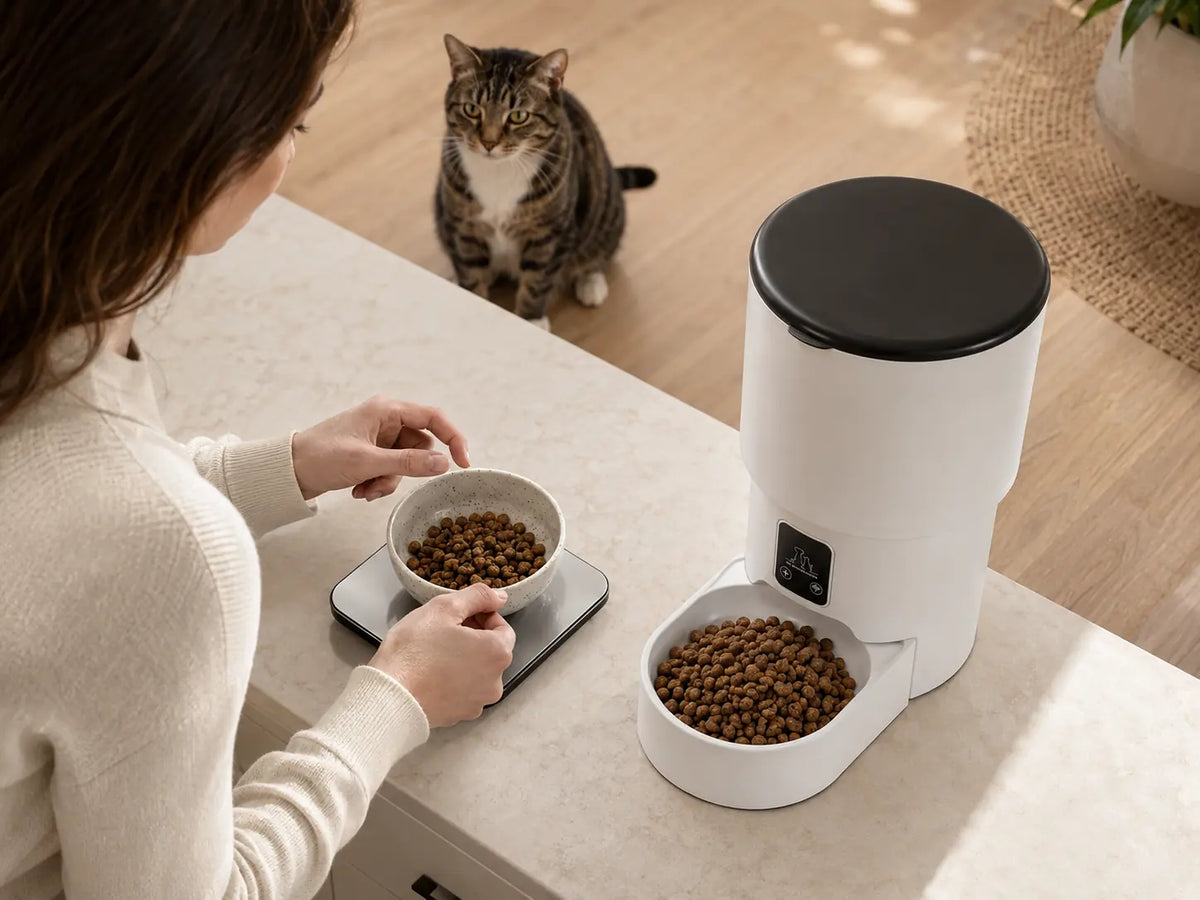
A kitchen scale is often more consistent than a volume cup. Weigh the empty bowl, tare the scale, and add the target amount. If using a scoop, level it the same way each time and occasionally verify its gram weight.
Calibrate the automatic feeder
Dispense ten portions into a bowl, weigh the total, and divide by ten to estimate the average. Repeat the test to account for natural variation. Kibble size and shape can change output, so recalibrate whenever you switch food.
Account for every source
Treats, dental snacks, table food, food stolen from another pet, and meals offered by multiple people all add up. A simple household note or app log can prevent double feeding. Set a daily treat allowance instead of offering from an unlimited bag.
Monitor more than bowl emptiness
Track body weight and body condition over time with veterinary guidance. Also notice appetite, vomiting, stool, energy, and drinking. A sudden change in eating behavior is information, not a reason to simply change feeder settings.
Practical checklist
- Confirm an appropriate daily target.
- Measure in grams when practical.
- Calibrate the feeder with current kibble.
- Include treats in the total.
- Reassess with a veterinarian over time.
Frequently asked questions
Are feeder portions the same as tablespoons?
Not necessarily. Each model defines a portion differently, and kibble shape changes output. Weigh test servings instead of assuming a universal conversion.
Should I reduce food if my cat gains weight?
Discuss changes with your veterinarian. Safe weight management should consider the complete diet, body condition, health, and rate of change.
This article provides general educational information and is not veterinary advice. Contact your veterinarian about health, nutrition, or sudden behavior changes.